

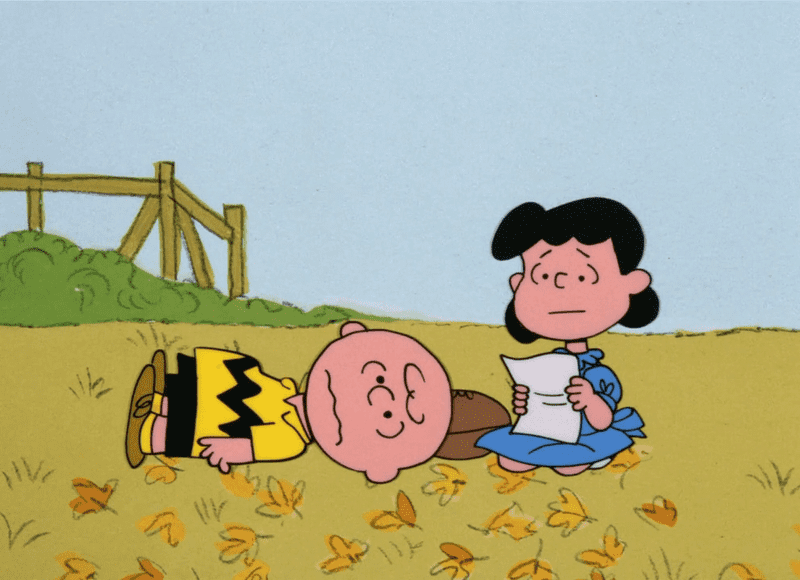
I remember few episodes of Peanuts, when Charlie Brown tries to kick the football and Lucy van Pelt keeps pulling it away last minute, making him fall on his back every single time. Every time she convinces him to kick the ball, and every time he questions trust. Lucy would convince him with different tricks; When she was a psychiatrist, he asks “After all, if you can’t trust your own psychiatrist, who can you trust?” Once she brings in a signed document saying “This time you can trust me…See, here’s a signed document that says you can trust me” and Charlie replies: “It is signed. IT’S A SIGNED DOCUMENT! I guess if you have a signed document in your possession you can’t go wrong” only for him to go running like every time and fall on his back because “peculiar thing about this document, it was never notarized”.
So what is trust, then?
We have plenty of examples of why we can’t trust others and mistrust has been a part of our evolutionary history; Our ancestors who trusted less, had more chances of survival. Sometimes it works, and we’re giving ourselves a well-deserved pat on the back: “hey, you did the right thing”. More often than that though, we are wrong, and the hunter gatherer’s era is gone. We need trust. Without it, our communities, organisations, society couldn’t function at all.
Pulitzer award winner, Erik Erikson said that we face a crisis in the first year of our lives that determines how strong our urge for comfort, predictability and reliability is. If the caregiver (usually the mother) responds predictably, reliably and lovingly towards us, we develop a strong sense of trust. This predictable, reliable, loving sense of trust helps us create communities and work together. We can safely say that trust starts from the moment you are born and it grows “step by step”.

Father helping his daughter walk
Key to being trustworthy is to act consistently at all times and in all circumstances, for yourself and for others.
“It takes twenty years to build you reputation and five minutes to ruin it” – Warren Buffet
Trust is probably the most beneficial value in relationships and organisations.
The first box every leader should tick is to inspire trust in others. This ability (many psychologists consider trust as a personality trait) is the foundation stone for every organisation, relationship and success story.
- Are you trustworthy?
- What makes people trust you?
Before considering gaining someone else’s trust, you must trust yourself; you must have credibility for yourself, first. Self-trust is derived from your capabilities to keep your promises, set and achieve goals and get results. If you “walk your talk” you’re on the right track. The inner sense of satisfaction and consistency will reflect on others and they’ll soon start trusting you too. If you don’t know what self-credibility is, ask yourself this: Do I keep the promises I make to myself? E.g. : I’ll stop watching TV, I’ll give him/her a call in 5 minutes, I’ll start exercising, and so on…when you don’t keep your promises to self, you’ll make space for procrastination and soon your unconscious self won’t see the value in your actions, hence it will start making excuses instead of being proactive.
Enhancing credibility for yourself and inevitably, for others
Credibility is something you can build and boost by making decisions and taking actions in line with what you believe in and what you stand for. Equally, you’re breaking your own credibility when you make decisions you don’t feel good about or against your values.
Taking it step by step.
Integrity. Integrity is known as “the quality of being honest and having strong moral principles”, but there’s much more to it; integrity is putting more effort in what is right rather than being right, being brave and being congruent – making your beliefs and values blend in a beautiful scent you can proudly wear anywhere you go.
How do you boost it ?
- Start by making and keeping personal promises. This might sound exciting and you’ll probably feel like over-committing …Less is more. Add weight to your promises. Make them matter! If you want to start exercising, promise yourself you’ll do it for 30 minutes instead of 1 hour; Promise a friend you’ll be there, be there! Remember, friends will always accept a good excuse, but your own self, won’t. And it will understand that excuses are the way to go.
- Be open and honest – It takes courage to say ‘no’ and to admit that we don’t have everything sorted out. Embrace that. Instead of making a commitment you can’t keep, look at an objective overview of why it cannot be done (not an excuse).
- Create your superhero – this is my favourite! Think of yourself as someone great and create a routine for that someone. What actions would he/she take? Will he/she be there when their friends need them? What books will he/she read? Keep that superhero up and running!
Intent. Why is Intent a part of my credibility, you may ask. Intent is a huge part of credibility because it’s driven by motivation – both intrinsic and extrinsic – and behaviour.
How do you improve intent?
- Check in with yourself once in a while. Sometimes we get so hyped in achieving a goal, that we forget to check what motivated us in the first place.
- Be loud and clear about your objectives. That will align your intention to your goals and people will know what to expect from you – no surprises there.
- Practice altruism, not selfishness. Be supportive to people around, don’t compare yourself to others and don’t hate others for what they have achieved.
Capabilities. Capability is a great combination of talent and skills. Your either born with it or you get to master something through learning in your lifetime. That’s why some managers are perceived as leaders, because they have a knack for leading others and inspiring trust.
How do you improve capabilities?
- Update and Upgrade. That’s the good news here, whether there’s something you’re born with or an ability/skill you learnt, you can improve, excel and master it. Do that!
- Find your strength and use it. Don’t waste time focusing on weaknesses (acknowledge them though – that will help you know yourself better)
- Have you map handy. Know where you’re going, nobody likes to follow someone who’s lost and lacks confidence.
Results. Results are important. Only when you have tangible and visible results your credibility boosts both within yourself and in front of others.
How do you get more results?
- Be accountable for your actions and take responsibility. Think of the task you want to complete and follow anything in your power and control to do so. If it doesn’t work, try again, try different, use connections. Don’t blame people or organisations.
- Be persistent
- Celebrate your wins! It may sound cliché, but hey! You did it! No matter how small your promise to yourself has been, you kept it. Keep it up!
Reflection.
A significant way to show credibility is to willingly make the choice to trust others. We are wired to believe in people who believe in us, and it works magic both ways, just like a mirror. When someone says: “I trust you”, you’ll give your best to make that person believe they made the right choice to trust you.
Trust is actually contagious: you receive it, you have it, you give it. If you need one more example of this contagion, think of F1 drivers: every single member of the team trusts that the other member will do exactly what they promised to do, so that they can win the race or the championship.

Lewis Hamilton with Mercedes team – Circuit of Americas 2015
Restore.
Say you started well, got someone to trust you and then … You broke that trust. For whatever reason that happened and no matter how much you screwed up, be a good connoisseur and restore this great piece of art. First, try to fix the initial problem. If that’s not possible, work hard to make the person trust you again, coordinate your actions (remember consistency is key), sew the pieces back together and do better in the future.
“We must trust and believe in people or life becomes impossible” – Anton Checkhov
 As Simple As That - HR and Leadership Coaching