A thinking model that makes you a leader

There are many leadership styles: democratic, authoritative, coaching, visionary, lessez faire -which comes from French – and literally means let it make (or non-literally and which makes more sense – let it be) – and so many more. And if you don’t know which one fits you, I’m sure that you can find many online questionnaires and quizzes to find out in 15 minutes or less which style is yours.

But, I want to talk about two other types of leaders: the formal and informal leaders.

Photo by Ashutosh Sonwani on Pexels.com

A Formal Leader is someone who has a title, someone who has been appointed as a leader: in politics, organisations, groups , communities and even families.

An Informal Leader is someone who is naturally followed by people because of their attitude, because of their power to influence or because they represent a model for those who follow them.

Use the following thinking model to become an informal leader at home, at work or in community. This model of thinking will significantly improve your mindset and will empower you on a daily basis.

This model we often use in coaching, is called above the line – below the line thinking.
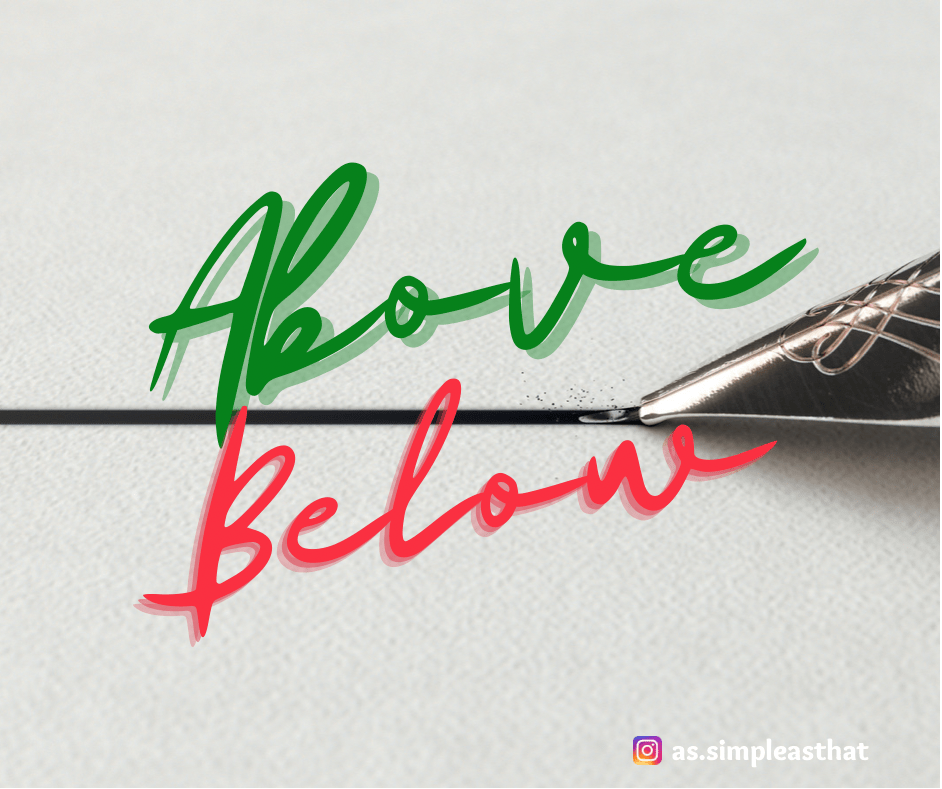
Above the line

For the sake of the exercise, lets draw a horizontal line – just like in this picture. Spoiler alert! To be a functional human being you must always try to stay above the line.

You may have heard of this thinking model , it’s often referred to as victims vs victors, or fixed vs growth mindset, but no matter how you call it, it’s still going to be easier to see it as above the line, below the line.

What does this model do for us?

It allows us to become solution oriented, rather than problem driven, it allows to deliver outcomes, results and detangle the wires that keep us stuck.

No problem can be solved by the same level of consciousness that create it

Albert Einstein

What this quote actually says is that we cannot solve a problem with the same thinking that created it.

Let’s see what below the line thinking looks like:

Photo by MART PRODUCTION on Pexels.com

Below the line we have: blame, excuses, justification, denial, avoidance, that victim mentality – where it’s not our fault, or someone else must come to rescue, there is always a problem band almost never a solution.

See this below the line thinking example when receiving feedback:

“Alex I think you could’ve been softer with that customer, although he was rude, he was right, we absolutely done wrong by him.” A reply with below line thinking would sound like this: yes, but!( whatever comes after “BUT” is useless, just as if you would take a sponge and erased it) yes, but, he was yelling or << insert any excuse >>

With answers like this, we do not allow ourselves to grow and to learn. We do not create choices, we do not look for resources instead we choose, consciously or unconsciously to stay the same and as a result of holding on to this thinking we experience overwhelm, stress and even anxiety and depression. It doesn’t mean we can immediately change it, we sometimes come up with defensive answers, excuses and blame because we are not aware that we blame and make excuses – plus! nobody likes to be criticised and corrected.

Above the line we have the opposite: we have responsibility, accountability, ownership, solutions, choices – no excuses, no blame.

Photo by Olga on Pexels.com

This is where a functional adult sits. Above the line is where we consciously choose what is happening, we are in control of our thinking, of our actions and responses – when we reach here life happens for us – not to us – just like Tony Robbins says.

This is where the victors are.

The easiest way to step above the line is to make a decision to stay open, curious and grateful.

An above the line example for the above feedback, would be: I appreciate you bringing this up, I will definitely use my empathy next time, after all, I understand very well what he was going through”.

Is this something easy to do? Absolutely NOT.

We all have different backgrounds and environments and sometimes we learn that it’s ok to make an excuse – “they will understand” – oh sorry I’m late, the traffic was terrible . Sure.

You know what? Nobody cares! You can use millions of excuse and live in blame and justification as much as you want; people move on, the world moves on. The only one who will have something to lose is you! Why? Because you let go of your power to something that is outside of you, you allow traffic be more powerful than your own will to leave the house a bit earlier and make it on time. And if you let go of your power one excuse at the time, what are you left with?

This thinking model is one of the first things that will make you an informal leader. To become an informal leader is rewarding because other people see an example in you, they see someone who they want to model – a formal leader, on the other hand it chosen by a title, their power disappears as soon as that title changes.

Who do you want to be? Where do you want to sit… below the line or above the line?

Do you trust your colleagues?

Photo by Canva Studio on Pexels.com

A few years ago, I was in a training to become a trainer for a topic I was (and still am) in love with – Emotional Intelligence. I made friends with most of the attendees, which was fun. For a couple of hours.

At some point, the trainer asked a question:

Do you trust your colleagues?

I was in my early twenties and I thought… this is no brainer… of course I do! so I say “YES” out loud. And all (ALL) other attendees said NO almost at the same time.

I was a bit confused, but I figured, it’s ok…we have a trainer, we’ll be ok, she will explain….

And the trainer looked at me and asked me again: Alex, do you trust your colleagues? I turned all red, everyone was now looking at me, I was after all the ‘odd one’ and they were all waiting for me to answer.

Someone else from the group decided to change their answer and say: “yes, I also trust them, until they prove me wrong.”

I said: yes, I do… barely hearing my own voice, honestly; and slightly questioning myself at this point.

To which she replied …. “See, you can’t trust anyone. We are all here to do a job, and that is all there is to it. We are all different, I can’t be sure that you will do a great job at hiring the right candidate (I was in HR) because I don’t know how you judge characters, for example”. I mean … she made a point. My colleagues seemed to enjoy it and agree with it.

I insisted a bit more on how we need to trust our colleagues but I have to admit I wasn’t prepared enough for that conversation back then.

But now… now I have a few questions.

1. If you can’t trust your colleagues to do their job, how can they trust you to do yours?

2. If you trust your colleagues until “they prove your otherwise”, is it trust, really? Or is the opposite of it (suspicion, distrust); basically just waiting for the other person to fail and then “prove” you that you “were right”.

3. Do you trust your friends?

Who do you really trust?

There is one thing that is common to every individual, relationship, team, family, organization, nation, economy and civilization throughout the world – one thing which, if removed, will destroy the most powerful government, the most successful business, the most thriving economy, the most influential leadership, the greatest friendship, the strongest character, the deepest love. […]

That one thing is trust

Stephen M. R. Covey

“You see”, trust is something we learn from a very early stage of life. Trust is mutual. Trust is earned. Trust is built. Trust is learnt. Trust is taught. Trust is a feeling not a task.

And trust starts with yourself. Having trust in yourself is about the simple things: keeping your promises and your commitments, becoming believable to yourself and to others, doing what you say you’d do and staying tru to your values; it boils down to one, even simpler, question: Am I someone I would trust?

I’m not saying you should be gullible, let people mock you or walk all over you. That’s not trust in the first place. Build healthy boundaries and don’t allow people to take advantage of you and at the same time, do some homework on how to trust yourself and others.

Self trust is the first secret of successthe essence of heroism

Ralph Waldo Emerson

Are they braver or did we lack information?

I recently saw a video of Hugh Jackman saying that he comes from an era where speaking up and speaking the truth was just something “we didn’t talk about”.

There is a 20 years difference between me and him and a whole lot of cultural and social differences too, yet how the hell is this still valid and how come we still do that “we don’t talk about that stuff” stuff?

This is related to the Olympics, and how some of the players decided to prioritise mental health rather than the competition.

It’s not how I wanted it to go, but I think we’ve opened bigger doors and bigger conversation

Simone Biles

Mental health is one of those topics that is very common yet very personal, social media is full of DOs and DON’Ts yet the real struggle isn’t in reading and liking posts, but in making a decision about your life, a life that may seem perfect, luxurious, unattainable for most… but which doesn’t fulfill you and doesn’t make you feel you own it… instead it feels like it owns you.

It’s not surprising that more and more athletes are making a decision to value themselves and their wellbeing because we do live in unprecedented times (I’ve heard this word so often in the past couple of years, that it changed it meaning to a sarcastic one). We spent more time indoors and online in the past couple years than we ever did in the past years.

And with so much of information literally at our fingertips, isn’t it easier to be more informed, understand that we are not the only ones struggling and that we are not alone?

To Hugh Jackman’s point… yes. The times were tough. People, not only didn’t have so much access to information (and we overall were interested more in how the world works than how we – individually – work) but they were also surrounded by stoics who would rather keep the walls up than show a slight of vulnerability. Vulnerability was seen as being weak.

The question is, what do we do to change this? These brave girls opened the bigger doors and bigger conversations, but are we ready yet to handle them ?

Just because you don’t want to talk about it, it doesn’t mean it’s doesn’t exist. Just because you don’t see it as a problem, it doesn’t mean it’s not a problem.

The masks we use to cover our authentic self

Do you have a friend who’s always funny? How about the one who has their life together and everything is always perfect?

I should probably start by saying that I’ve worn some of the masks I talk about in this article and I didn’t know they were a way to stay away.

So, I trust this information comes in handy, it brings you some awareness and perhaps it helps you gain some insights about how we behave.

Our authentic self is confident, curious, trusting, playful, full of love and acceptance for us and for others. As we grow up, we develop defense mechanisms to protect our authentic self and to keep us alive. If you lived in a family where you learnt how to keep your authentic self intact, this is not for you. If you didn’t, keep reading.

Photo by Sharon McCutcheon on Pexels.com

Depending on what we see in our homes and how we perceive our family and the world in our youngest years, we develop and add these protective layers on top of our authentic self and soon we start showing up as the masks we have so carefully and unconsciously built for ourselves. As we explore life and show up as our masks, others add their ideas on top of our masks, making them heavier and harder to remove.

For example, if we develop people pleasing tendencies (of going above and beyond for others, always being nice and kind) the more other people reinforce these traits in us, the harder it is to create boundaries and put ourselves first because the weight of the mask becomes emotional: if we start putting ourselves first, we will feel like we let people down, so we’ll continue to live up to unrealistic expectations set by people who may not even care about us.

It is important to identify what mask you are wearing and what defense mechanism you use as a result of it so that you can heal from past wounds and experience deeper intimacy with your loved ones.

Photo by Kamil Rybarski on Pexels.com

Very common masks that we wear to protect ourselves:

  1. The Clown – Using humour, jokes and sarcasm as a defence mechanism to hide pain and to avoid intimacy.
  2. The People Pleaser – Going to desperate lengths to win the approval of others because their sense of identity is based on other people’s opinions which makes it really hard to make decisions on their own and very easy to be influenced by others.
  3. The Mr / Mrs Perfect – Making sure that others know they are ok, minimising what they are going through, always showing up happy, keeping the perfect image, bottling up emotions and dismissing their own feelings.
  4. The Hero – Trying to save everyone, making themselves available for anyone at any time, sometimes in the detriment of their own wellbeing. Because of their desperate desire to save everyone and the drama they bring with it, they tend to push away the very people they try save.
  5. The Bully – Using hurtful and mean language to hide their own insecurities. Behind their hostile behaviour lies low self-esteem and lots of self-doubt.
  6. The Control Freak – Using order, power and organisational skills to run away from ambiguity and uncertainty. Everything must be neat, they are in need of constant assurance, they take responsibility for everyone and leave no one out of sight.
  7. The Self Critic – Constantly projecting a negative self-image, using this mask as a protection mechanism, thinking that if they do it first, others can’t do “worse” than that.
  8. The Social Butterfly – Filling up their schedule with as many activities as possible, they meet many people, attend many events, he / she is the busiest one. They make many acquaintances but really few (if any) real friends. They hide their insecurities behind small talk and superficial conversations.

Other masks: The Troublemaker or The Black Sheep – taking all negative attention on themselves to ‘protect’ others,  The Caretaker – Constant need to support others, feeling guilty and uneasy when receiving support, The Patient – Constant need of attention, often falling sick when attention is not given, The Invisible One – trying to make it through life with minimum attention, avoids conflict at all cost.

What’s the key learning here?

  • We create masks because of an unconscious fear that our authentic self may not be loved or accepted by others.
  • Family, friends and society keep reinforcing the masks and as a result we keep wearing them.
  • As long as we live up to other people’s expectations, we will keep flaunting our fake selves around.

Are you using any of these masks?

Can you go back in time and identify the first time you started wearing a mask?

Becoming aware of these masks is not about blaming others for creating and wearing them, nor about removing them completely. It’s about understanding … how did they help you? Do you still need them?

She had blue skin,

And so did he.

He kept it hid

And so did she.

They searched for blue

Their whole life through,

Then passed right by-

And never knew

Shel Silverstein

Always

The word that could damage someone’s perspective of the world and reduce their self-confidence significantly, if you use it continuously to ‘correct’ their actions, highlight something they’ve done or provide feedback.

It affects adults, but it affects children even more.

The other day I was at the mall and next to me there were 3 women with a little girl.

The girl was upset because she spent the money she got from her mum and now she wanted more because she saw something she liked.

I was watching the whole situation and I was genuinely curious to see how the mother will handle this. I was in for a very disappointing view.

The mother grabbed her forearm and shaking it and squeezing it, said out loud: “You always do this! no! You don’t deserve it! … Always spending everything and then you come for more!”

Right when the mother grabbed her arm, the girl fixed her eyes into the floor and said nothing. No single word. She slightly tried to pull her arm, for like a second, but gave up really quickly when the mother started shaking it. She was listening to her mum shaming her in a public space, in front of two relatives, who seemed to be ok with it. And she kept staring at the floor. 

She’s about 4 – 5 years old…

It must exhausting to be a mother, I understand that. And if you choose to become one ( because it is a choice!), please choose to read some books about being a parent, talk to a specialist or two, for the love of the human being whom you are shaping and sending into the world. 

This is so not: my mother raised 3 kids and we’re all alive and healthy. This is: your mother raised 3 kids who don’t know how to raise one

To that girl: when you grow up, I hope you find someone to tell you that you’ve done nothing wrong! That when you are 5 years old, the only job you have is to be a 5 years old kid: to explore the world, to push the limits and to learn and to grow. You are not a financial adviser, you don’t need to ‘save your money’ and you have the right to be happy and try the things that your emotional, curious mind wants you to.

Your parents’ job is keep you safe, to love and nurture you and to create healthy boundaries that will allow you to grow and to learn. It is not to instill shame in you for the mistakes they make or to project their own issue and shortcomings on you. That’s never been a part of it.

To all the parents out there: before you use always on your child, make sure you never make a mistake. 

If you want children to be able to make decisions, you must teach, not demand, you must accept and love not shame and punish. 

Just because you lived it, it doesn’t make it ok to pass it on.

Why are habits hard to change?

The chains of habit are too weak to be felt until they are too strong to be broken.”

Samuel Johnson

Photo by Ketut Subiyanto on Pexels.com

Have you ever been told that you’re doing too much of something, or too often? that whatever you’re doing is bothering people around you, or that it’s bad for your physical and mental health? Perhaps you’ve thought of giving yourself a makeover in terms of habits and you want to change something old or do something new?

How do we get habits anyway? They are found in the same part of the brain that is responsible for memories, pattern recognition and coordination of movement. After you learn something new (eg: you learn to lock the door every time you leave the house), you do it consciously (willingly) multiple times until it becomes automatic and you’ll soon do it without thinking about it, unconsciously; it’s a habit. You may even ask yourself at times: did I lock the door when I left? And you can’t remember. Only to come home later and to find that the door is locked, because “you were acting out of habit”.

Why is habit difficult to change? While forming a new habit could be easy, depending on circumstances, rules, social interaction and motivation, changing an old habit, is not as easy. Because it’s an automatic action that doesn’t require your decision anymore, it goes through stages. Have a read below to understand more:

  1. Precontemplation. The stage when you hear suggestions about the habit you need to change, but you don’t consider them. You have no intent to change the habit, and you refuse to even think about it: “it’s not a problem”, “it’s not that bad”, “it’s my life / my body, not theirs”.  
  2. Contemplation. You take a deep breath and you become aware about the effects your bad habit has. At this stage, individuals spend time doing the pros and cons, finding reasons and excuses to not changing anything; although they start to understand the negative aspects of their habits, they fail to see the long-term benefits.
  3. Motivation (Determination). If you happen to pass the contemplation stage, this is the step where you say: “I have to do something about this!”, but this is a difficult step too. For example, smokers will throw all their cigarettes at this stage, they’ll stop smoking for a couple of days and as soon as they have a social gathering, they will find a reason to ‘light one up’. So, what you need is a motivating and activating belief: it may be health, it may be the desire to become a role model for the children, to get the dream job … and so on; Find yours, spend some time to understand what will determine you to make this change. At this stage, most people come up with a plan: call a clinic, buy a gym membership, cancel credit cards – whatever suits the plan.
  4. Action. You are actively involved in changing your habit, the doing stage. You say you start going to the gym and you do! Every day; regardless of your schedule for the day. You watch your diet, get a personal trainer… This step is glued to your willpower. This is the shortest stage of all, however it does depend from person to person. At this stage, you become more open to receiving help and you are likely to seek support from specialists or peers.
  5. Maintenance. This part is the “ongoing action” and the longest stage. You continue the new behaviour, no matter what. Bad news is: maintaining a new habit is challenging. Connect with your motivation, the ‘why’ of your plan.
  6. Termination. The last stage; you have maintained your new habit long enough and now the old behaviour seems far-fetched. At this stage, most individuals are annoyed by their past habits (skipping a gym day brings frustration when it used to bring pleasure, if going to the gym was even an option)
Photo by Andrea Piacquadio on Pexels.com

Relapse is the door you don’t want to open, this is a stage that could come up at any time, between stage 3 to 6… people resume the initial unhealthy habits, because they relax or they get tired, they think they’ve done enough. In order to avoid it, you must go back to steps 3, 4 or 5. Remember, you are not born with habits. You learn them, you choose them and therefore you can change them.

Making a change takes more than willpower and good intention. Bringing critical thinking into it, definitely helps: “Exactly, how would this change be beneficial for me?”

Bad days and bad news come and go. Don’t let a couple of events influence what you started working on. When the motivating belief is strong, human beings are capable of showing unlimited amount of determination.

“The truth is that everyone is bored, and devotes himself to cultivating habits”

Albert Camus

This article is for general information only and is not meant to replace real treatment or diagnosis.  If you struggle with addiction, seek professional assistance.