Is corporate culture changing?

“When we are no longer able to change a situation – we are challenged to change ourselves”

Viktor E. Frankl

Photo by Anna Shvets on Pexels.com

Since the beginning of 2020 we have been living in an unrealistic scenario that we had only seen in movies before and we never thought it could become a reality in “our lifetime”. It’s been 6 months since WHO declared a Pandemic and 6 months since we’ve gone through tough times and changes.

Organisations have had a pretty rough transition, especially the ones where employees were physically required in the office; people went through the struggle of working from home (yes, there are many who hate working from home), micro-managers’ power of breathing down someone’s neck has diminished or it disappeared; work travel slowed down or stopped, many people lost their jobs and some had to go to a new role or reinvent themselves and chose a different path.

How do we cope with this change?

Our greatest gift is adaptability, and no matter what is thrown at us, we survive it! (that’s also what made us the greatest enemy of our planet, yes…).

Corporate culture is one of the most common subjects when it comes to organisations today. You hear it in interviews, from candidates trying to understand where they will work: “What is the culture in your organisation?” or the interviewer “She / he didn’t fit our culture”, you hear in friendly chats: “Mate, I’m done with this company, I don’t like their culture”, you hear it in management meetings: “Let’s drive a culture change, I want my team to behave more like this and less like that”  

But what is corporate culture?

Corporate culture could be defined as: Patterns of accepted behaviour and the values that support them. They are “patterns of accepted behaviour” because what may not be acceptable in some organisations, it’s acceptable in others: “Here, it’s ok to take a 2 hours lunch break as long as you meet your deadlines”, “we wear business attire everyday” , “it’s ok to come in at 10am if you stay till 7pm ” or “no one stays late in the office, work-life balance matters here

Corporate culture is important because it is unique to each organisation and it’s a part of company’s identity. More often than not, corporate culture is implied, not defined in a black and white text; it will reflect in dress code, hiring decision, turnover, office hours, office setup. Culture is mainly given by: vision, values, practices and people. Let’s look at them one at the time:

Vision: This is the purpose of the organisation, the “why” and the “where” together.

Values: They shape the culture from the inside out. Values are a nice blend of the beliefs and the philosophies behind the vision.

Practices: An organisation’s values and vision fail if practices don’t support them: writing “honesty” in block letters as your main value but not allowing your employees to discuss issues openly is a major discrepancy between values and practices. They need to work hand-in-hand.

People: Your glue to values, vision and practices. The cherry on top.

Will Covid19 impact corporate culture?

Photo by Anna Shvets on Pexels.com

It already has, absolutely. Moving people from face to face interaction to zoom meetings is a change in practice. “Business attire” to a “home office attire”, booking meeting rooms in advance to picking up the call while cooking dinner; these are changes that impact the corporate culture; “open door” policy is now a matter of “Is this is the right time to talk?” or choosing not to call at all, the ‘9 to 5’ became 8am to 8pm (or later) so yes, the current situation impacts people, impacts working style, impacts organisations and changes culture.

How do we move forward? There are two types of change:  the evolutionary one, sweet and smooth, and the disruptive one, quick and painful. Unfortunately, the one we’re going through right now is the disruptive one. In order to make it easier for us, we need to understand when do people accept disruptive change? Short answer is, we don’t like it. However, we accept disruptive change:

  1. When it’s effortless. Covid19 did not make it easy on people: redundancy, termination, working from home. However, what we see as easy change is “I have everything I need to do this (the skills, the technology to make a home office) and the business supports me to do it
  2. When it’s rewarding. “Working from home will be beneficial for the safety of my community and my own.”
  3. When it’s common. We want to be part of the bigger group. In order to change, people need a sense of belonging, normality or similarity: “People like me, are doing the same thing, we all work from home” – We are wired to be together and we don’t like to stand out; even when we do want to stand out, we admire other people like us, who stand out which brings us back to the sense of “belonging”.

If transitioning to working from home was tough on your organisation, go back to your vision, values and people and use the 3 steps above to make it successful and smooth. It will also help if you keep consistency in your behaviour: if you used to personally check on each employee in the office, why not do the same online? Drop them a text on Monday and to find out about their weekend activities, or ask them about that important meeting they had last Wednesday. Don’t forget their birthdays and encourage your team to keep in touch with each other.

“When you come out of the storm, you won’t be the same person who walked in. That’s what this storm’s all about.”
-Haruki Murakami


How to lead successful change

The world as we have created it is a process of our thinking. It cannot be changed without changing our thinking.” – Albert Einstein

People change constantly: in a lifetime everyone goes through personal transformation from infancy to young adulthood, middle age and finally to old age. A career path may lead from subordinate to junior management, middle management and eventually board level or consultancy. Organizations also mature and evolve, with major changes on many levels in policies, culture and practice. Increasing your capacity to understand and drive change could be beneficial for personal satisfaction and career progress.

Creating a change plan for your organisation is not easy, especially if you’re at the beginning of the road. Today’s leaders are trying to adapt to the realities of this fast paced world and they face a serious and contemporary problem: they must transform their organisation from an idea to a tangible product, from losing to winning, from zero to hero. All that happens with little to no time for the employees to adjust to the new way. Times of change are challenging for leaders, and even more challenging are times when they need to plan, implement and drive change.

There is little, if any, black and white guidelines that work in organisations. In order to be successful, a change process must:

  • Be a multi-phase process
  • Be dynamic; you need to learn or expect to make adjustments as you go
  • Establish a common understanding of the performance that is required, from leadership to employees
  • Create a comprehensive approach that links individual efforts to your change objectives
  • Recognize that change will occur at different stages and times throughout the organisation (some employees or departments will cope with change faster than others)

The ideal change management plan combines aspects of both strategic and tactical planning. Here are five steps you can take to create it.

1. Clarify the reason behind change, the end goal, and at the same time, clarify what will not change.

Start with providing clear guidance and better understanding for your employees. Often it is helpful to create a change vision – board. Clarifying the purpose will help your team understand why is change important. Defining an end goal will help them picture what it will look like. Letting your team know what will not change will minimize the fear and uncertainty. In effect, you will be providing stability in the midst of change. Times of change are stressful.

Tips: If you are to initiate the change, make sure you work with those who are to understand the big picture and goals. Discuss how you and your team are expected to support the change. By this, you will designate who plays what role in implementing the change. This step is important because: It conveys the sense of urgency and need for change; it will help you assess readiness for change. It designs the expected end state. It builds trust and commitment.

2. Build rapport and ownership

The more you involve your team in the change plan, the easier it is for them to accept it and implement it. Acceptance is best achieved by involving those directly affected by change in planning it. Communication is vital here.

This step is important because: It helps you evaluate the impact. It identifies common themes. It creates the change strategy.

3. Design change management initiatives

By now you will be able to work on specific actions, guidelines, roles and timeline of execution.

Tip: Discuss these with your team and as appropriate ask them for feedback and inputs. Designing the activities will help you set priorities. Avoid overwhelming everyone with too much change at once.

This step is important because: It identifies specific change initiatives. The change plan becomes more tactical now.

4. Implement change

Execute your change plan and keep moving forward. Procrastination can create inertia or confusion. Timely implementation of the plan reaffirms the importance of change and your commitment to see it through.

Tip: Monitor the status of plan implementation.

5. Learn and Adjust

Throughout the change process it is important to keep the communication open. You want to get feedback from your team, you want to stay on top of any unexpected consequences that have emerged and have to be dealt with. It is necessary to have a dialogue with those affected by the change.

This step is important because: Most change plans have failed due to the inability to adjust or learn from mistakes.

Tip: Make feedback part of your change culture. Don’t be afraid to modify the plan including the time frame. Be patient. Ways to collect feedback: Change plan reviews; Informal discussion; Regular team meetings.

The best leaders are those who can deal with ambiguity and change, and those who make it easier for their team to follow through. Companies who fails to keep up with change are inevitably left behind. Successful leaders are those who not only acknowledge that change is essential, but they go an extra mile, embrace change and use it as a muscle to move the organisation forward.

“To improve is to change; to be perfect is to change often” – Winston S. Churchill

How to find your purpose

Photo by Thought Catalog on Pexels.com

The purpose of life is not to be happy. It is to be useful, to be honorable, to be compassionate, to have it make some difference that you have lived and lived well” – Ralph Waldo Emerson

Why is purpose so important? Have you found yours?

Do you really have to have a purpose? What if you are “happy” without it? Or … are you happy without it?

Research have shown that believing you are making a difference and that your life has purpose is fundamental to your well-being. Purpose in life is important because it provides you with a strong base and a sense of direction which will ultimately help you reach the goals you set.

Best way to find your purpose in life is to fast forward to the end of it. Don’t freak out, it’s “safe to practice” and it only takes imagination and honesty while answering below questions:

  1. What do I want to be remembered for?
  2. Whom do I want to be remembered by?
  3. When I look back, am I satisfied with the life I lived?
  4. Am I living in a way now that will help me achieve my purpose?

If the answer to question 3 and 4 is “no”, start thinking of adjustments you can make in your daily life to move towards your desired self. What can you do? What is within your control? What can you start doing right away? I trust that you answer all the questions honestly.

Some of us may think that life purpose should suddenly become clear and that we’re doomed without one. But this is a rather slow process, it takes motivation and continuous effort.

For many people, thinking of life purpose can be uncomfortable or it may seem abstract, especially for those who are not spiritual and don’t believe in a higher order of things.

And for others it may mean following some odd (and old) traditions or superstitions linked to the life they lived to date. Traditions and superstitions should not affect your life purpose in any way.

Most us are working a daily job, thinking of building a career, and when asked about it, we’d often answer: it’s a job, it pays the bills so it’s ok… Think of an option that isn’t about you and the job you do, but more about the relationship you have with your job. That is job crafting.

To start crafting your job, rather than working a 9 to 5 schedule, read through the below changes you may want to apply:

  1. Change the number, scope or type of the tasks you do.
  2. Change the nature (or number) of the relationship you have: connect with (more) colleagues, reach out to stakeholders.
  3. Change the way you perceive your job by looking at how it contributes to wider organisational success and why not, to global success.

Re-crafting your job is a way of adding more meaning to your life. Even if you feel like the first 2 might be out of hand, the 3rd point is definitely something you can do. Meaning at workplace is given by two opposite stand points: intrinsic – the individual personality characteristics and extrinsic – job specific characteristics. It’s in your hands to determine which one wins. (why not both of them?)

Photo by Pixabay on Pexels.com
Not related to life purpose, just a glimpse of kindness

To go even deeper, answer the following questions for yourself:

  1. If you were given the opportunity to create your own job description within your organisation, what will it look like?
  2. How would this “ideal” job be different than the one you currently have?
  3. Why would you make this change?
  4. What stopped you from making this change earlier?
  5. What will enable you to make this change?

Purpose is personal and it’s different for each individual. Two people doing the same job may have completely different purpose in life and different meaning for what they are doing.

There are several pathways to discover your purpose and it certainly helps to be inquisitive about yourself and about others.

Psychology theories suggest that there are few pathways which lead to purpose in life:

  1. You can proactively think of your purpose, work on it, and gradually define it until it becomes crystal clear.

2. You may experience a life changing event: Giving birth to children – if you didn’t know, yes! having children is a life changing event; and so are serious illnesses and near-death experiences – or NDEs – which, I hope none of you will ever go through. These events change people and their purpose will shift, they’ll think of something new, that wasn’t even in the radar before.

3. You may find your life purpose by observing others, learning from them and by modelling them.

Being curious about things will always bring you closer to discovering your calling.

Your purpose in life is to find your purpose and give your whole heart and soul to it.” Buddha

Control and influence or learn to let go


Puppeteer – Kamilla Zarbaliyeva

“If you don’t like something, change it. If you can’t change it, change your attitude” – Maya Angelou

Human beings seek control and dislike uncertainty, ambiguity and the unknown. We have expectations and we put our hope in people, situations and organisations. We go to work and expect to get a promotion, we make a friend and we expect support, we plan a holiday and we expect it to meet our dreams. Yet , it doesn’t work this way, it doesn’t always happen to have your expectations met. And that’s when you get hurt, you suffer, you hate others for getting “what you deserved in the first place” , you quit, you have negative thoughts and there goes the long chain of bitterness.

Why do people get stuck in the chain of bitterness? Because they can’t seem to understand their area of control and influence and more importantly the area where they don’t have any of them.

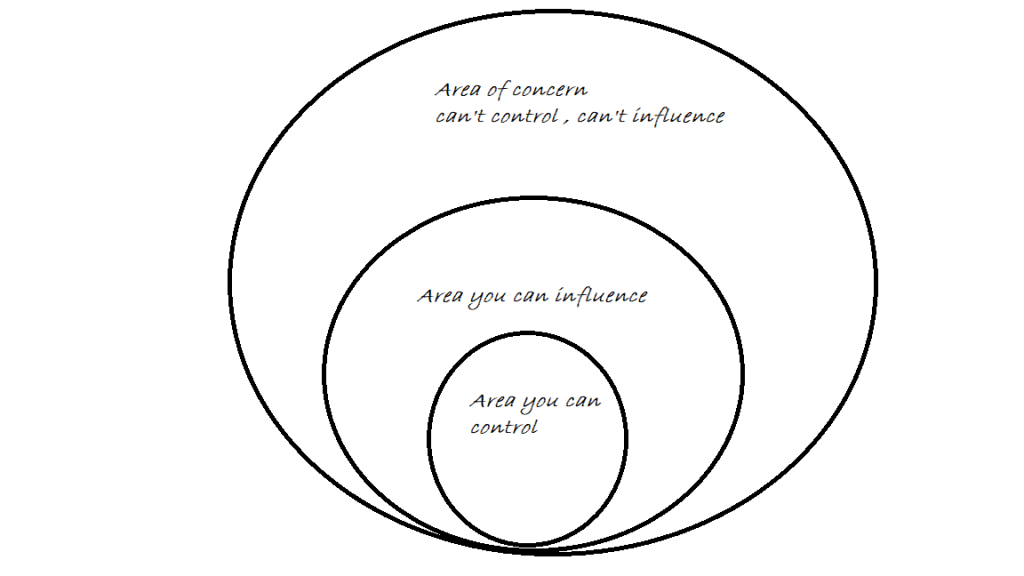
Take a look at the sphere below:

At the core of it, it’s you and the wonderful area you can control.

Immediately outside it, is the area you can influence.

Once your influence area ends, there’s a massive area of concern and unknown that you can’t control or influence.

For example:

You can control the time you leave the house but you can’t control the traffic to the office.

You can influence your colleague to cover for you but you can’t control what she thinks of you.

The world is full of triggers that fill you with frustration, disappointment, jealousy and pain.

What can you do about it?  

Focus on the things you can control and influence.

Start by acknowledging what you actually control and influence everyday ( eg: what time you wake up, what you have for breakfast – whether you choose to have breakfast at all, what means of transport you use to go to work, how you respond to people, your attitude, how much effort you put into what you do) and less on what you can’t influence or control (what people think of you, how bad the traffic gets on your way to work, what others achieve, what the weather looks like)

A great way to get going would be to start using the sphere and write your own details in each part of it. If you’re still confused whether something is in your control or not, ask yourself : Can I change it? Can I do it differently? If the answer is yes, then you control or influence the task, hence the outcome depends on you.

If the answer is no, don’t beat yourself up, work on enlarging your sphere of influence/control by connecting with people and investing in yourself. Will share more tips and tricks about this in future articles.

“Life is to be lived, not controlled; and humanity is won by continuing to play in face of certain defeat.” – Ralph Ellison, Invisible Man