Is corporate culture changing?

“When we are no longer able to change a situation – we are challenged to change ourselves”

Viktor E. Frankl

Photo by Anna Shvets on Pexels.com

Since the beginning of 2020 we have been living in an unrealistic scenario that we had only seen in movies before and we never thought it could become a reality in “our lifetime”. It’s been 6 months since WHO declared a Pandemic and 6 months since we’ve gone through tough times and changes.

Organisations have had a pretty rough transition, especially the ones where employees were physically required in the office; people went through the struggle of working from home (yes, there are many who hate working from home), micro-managers’ power of breathing down someone’s neck has diminished or it disappeared; work travel slowed down or stopped, many people lost their jobs and some had to go to a new role or reinvent themselves and chose a different path.

How do we cope with this change?

Our greatest gift is adaptability, and no matter what is thrown at us, we survive it! (that’s also what made us the greatest enemy of our planet, yes…).

Corporate culture is one of the most common subjects when it comes to organisations today. You hear it in interviews, from candidates trying to understand where they will work: “What is the culture in your organisation?” or the interviewer “She / he didn’t fit our culture”, you hear in friendly chats: “Mate, I’m done with this company, I don’t like their culture”, you hear it in management meetings: “Let’s drive a culture change, I want my team to behave more like this and less like that”  

But what is corporate culture?

Corporate culture could be defined as: Patterns of accepted behaviour and the values that support them. They are “patterns of accepted behaviour” because what may not be acceptable in some organisations, it’s acceptable in others: “Here, it’s ok to take a 2 hours lunch break as long as you meet your deadlines”, “we wear business attire everyday” , “it’s ok to come in at 10am if you stay till 7pm ” or “no one stays late in the office, work-life balance matters here

Corporate culture is important because it is unique to each organisation and it’s a part of company’s identity. More often than not, corporate culture is implied, not defined in a black and white text; it will reflect in dress code, hiring decision, turnover, office hours, office setup. Culture is mainly given by: vision, values, practices and people. Let’s look at them one at the time:

Vision: This is the purpose of the organisation, the “why” and the “where” together.

Values: They shape the culture from the inside out. Values are a nice blend of the beliefs and the philosophies behind the vision.

Practices: An organisation’s values and vision fail if practices don’t support them: writing “honesty” in block letters as your main value but not allowing your employees to discuss issues openly is a major discrepancy between values and practices. They need to work hand-in-hand.

People: Your glue to values, vision and practices. The cherry on top.

Will Covid19 impact corporate culture?

Photo by Anna Shvets on Pexels.com

It already has, absolutely. Moving people from face to face interaction to zoom meetings is a change in practice. “Business attire” to a “home office attire”, booking meeting rooms in advance to picking up the call while cooking dinner; these are changes that impact the corporate culture; “open door” policy is now a matter of “Is this is the right time to talk?” or choosing not to call at all, the ‘9 to 5’ became 8am to 8pm (or later) so yes, the current situation impacts people, impacts working style, impacts organisations and changes culture.

How do we move forward? There are two types of change:  the evolutionary one, sweet and smooth, and the disruptive one, quick and painful. Unfortunately, the one we’re going through right now is the disruptive one. In order to make it easier for us, we need to understand when do people accept disruptive change? Short answer is, we don’t like it. However, we accept disruptive change:

  1. When it’s effortless. Covid19 did not make it easy on people: redundancy, termination, working from home. However, what we see as easy change is “I have everything I need to do this (the skills, the technology to make a home office) and the business supports me to do it
  2. When it’s rewarding. “Working from home will be beneficial for the safety of my community and my own.”
  3. When it’s common. We want to be part of the bigger group. In order to change, people need a sense of belonging, normality or similarity: “People like me, are doing the same thing, we all work from home” – We are wired to be together and we don’t like to stand out; even when we do want to stand out, we admire other people like us, who stand out which brings us back to the sense of “belonging”.

If transitioning to working from home was tough on your organisation, go back to your vision, values and people and use the 3 steps above to make it successful and smooth. It will also help if you keep consistency in your behaviour: if you used to personally check on each employee in the office, why not do the same online? Drop them a text on Monday and to find out about their weekend activities, or ask them about that important meeting they had last Wednesday. Don’t forget their birthdays and encourage your team to keep in touch with each other.

“When you come out of the storm, you won’t be the same person who walked in. That’s what this storm’s all about.”
-Haruki Murakami


Do you really know your colleagues?

“When you stop expecting people to be perfect, you can like them for who they are” – Donald Miller

Often at work, we try to stand out or fit in by acting in ways that we consider right to get us where we want to go.  Sometimes we complain about the boss who’s too demanding or that colleague who talks too much; we regret that one meeting we wanted to share our opinion and couldn’t …or perhaps talked too much when we shouldn’t.

I’m here to make you feel better and tell you that you are not alone and the way you deal with things says a lot about your personality type. Are you an extrovert or an introvert? Are you a feeler or a thinker?

Getting to know your teammates, will help you predict how they behave and / or adjust your style to make work relationships better. Predictions are a key factor in our decision making. Whether you decide to make a career shift or purchase a new car, your choice is usually based on the prediction that the selection you made will be more beneficial than others you have considered. Likewise, when you decide to act (or react) in a certain way, it predicts your approach or preference to dealing with situations and other people.

Talking about preferences, have a go at understanding these types. Read the statements below and choose the ones that describe you the most. These are preferences, choices / options you like more; not labels, not stickers; you may identify that you like options from both categories, however pick the one that describes you best; you will find that with some you will agree strongly, while with others just a little and with some not at all. Pick a letter from each category and the end you should have your own 4 letter type. *

Extraversion / Introversion (E – I)

E – You enjoy going to meetings and you tend to share your thoughts in different situations. As a matter of fact, you feel frustrated if when your voice is not heard.

– You may lose your trail of thought: “what was I saying?… oh yeah, about the event I attended yesterday … Errm… Got it! Mary got a promotion!”

– You recharge by being in a group; Being with people gives you energy and a “feel good” state; being alone feels wrong, empty or boring.

I –  You like to share special occasions with just one other person or perhaps a few very close friends.

– You wish you could get your ideas out more frequently; at times you may regret not stating your opinion out loud

– You recharge by being alone, reading a book, at home, is your “favourite time of the day”; large gatherings drain your energy, they’re exhausting.

Sensor / iNtuitive (S – N)

S – You prefer exact or specific answers to specific questions: when you ask “What time will you be there?”, around 2 is not the answer you want to hear. 2:20 is your preferred answer. And your friend better be there at 2.20!

– Daydreaming and fairy-tale talk are things you condemn. You find it hard to understand people who indulge on fantasies.

– You love facts and figures more than ideas and theories.

N – You tend to give general answers to questions and you get irritated if people want specifics.

– You would rather imagine how you’d spend your next salary than figure out the accounting of your last one.

– You believe that time is relative; you’re not late unless the event / dinner / party started without you. And even then… you made it, right? Why are they so bitter about it!?

Thinker / Feeler (T – F)

T – You manage to stay calm and objective in situations when everyone else is losing it.

– You don’t mind making difficult choices and you don’t understand why people are upset about things that are not relevant to the issue at hand.

– You don’t think it’s necessary to like people in order to work with them. Being right is better than being liked.

F – You consider everyone when you make a decision and you try your best to please them all.

– You put yourself in other people’s shoes: “What will he do if I fire him”? “How will my decision affect my team?”

– You find yourself wondering if others consider your feelings. “Does anyone care about what I want”?

Judger / Perceiver (J – P)

J – You ‘know’ that the world would be a better place if everyone will do what they are supposed to do, when they are supposed to do it.

– You don’t like surprise and this is not a surprise for anyone who knows you.

– You thrive on order; you have a special place where you keep your keys, everything on your desks is following a system; you have a system for anything, really

P – You don’t plan a task, you wait and see what it demands. People accuse you of being disorganised, but you know better.

– You don’t believe that order counts (although you do like it); you believe in creativity, spontaneity and responsiveness.

– You depend on last-minute energy rush to meet the deadlines. Don’t get me wrong, you make it to the deadline, but you may drive everyone else mad in the process.

Imagine an ordinary conversation between a sensor (S) and an iNtuitive (N):

S – What’s the time?

N– It’s late.

S – Seriously, what time is it?

N– It’s time to go.

S– (getting frustrated) I asked a simple. specific. question. Why is it so hard to give a simple, specific answer?

N – (moralizing) Relax, not everything in life is serious! Stop being so particular about small things.

I can already see some people taking sides, and that’s an insignificant chat scenario between friends; I cannot emphasize how important “a small detail” could be for your colleague or for your employee. Remember, Sensors are direct, realistic, factual and iNtuitives are inspirational, general, fantasy lovers; conversations like the one above will drive them both crazy in no time.

Question is: who’s right and who’s wrong? Both. None. Being an Introvert or an Extravert, a Thinker or a Feeler is not a matter of doing the right thing or not, it’s a matter of a “preferred way” to reach the (same) conclusion.

To understand this better, let’s look at how a T boss and an F boss would handle a situation of an employee being late when everyone should abide by the strict schedule of 0900 am to 0500 pm.

T boss: Susie, I noticed you were 30 minutes late today. This is a violation of our policy and you know it well. In all fairness, you must understand that this breach will not be tolerated and please consider this a verbal warning.

F boss: Susie, I noticed you were half an hour late today…I know you have a hard time taking care of your family; is this the reason behind your tardiness? We need you here on time, so let me know what can we do to help you so we can avoid being short of staff in the morning. By the way, how is your father feeling?

Thinkers are objective and ensure fairness by enforcing and maintaining rules while Feelers are subjective and ensure fairness by taking into account all personal matters and needs.

These couple of examples are meant to make you consider different reactions of different people as normal, if not right. Categorizing people is not completely wrong, our brain does it every day anyway: “Jan the manager, Susie the cleaner, Jake the engineer”; that’s a “boxing” system too. So what I’m saying is that it’s ok to try to find people’s fit, however, think carefully before you do it, these examples are only of a “letter” at a time, and while you may understand Introversion, iNtuitive and Thinking separately, you may still not completely know an INTP as a whole; the sooner you put the 4 types together, the more possible variations you get and the harder is it to label someone.

The key learning is that your style is as good as any other style as long as you keep learning and continue to improve your work environment to make it a better place for yourself, your colleagues or employees. I cannot stress more that this is not an excuse generator: “I’m a Perceiver, you know I’m always bad with deadline”; this is a power generator: “I’m a Perceiver, I’m adaptive and resourceful, so I’ll do my best to meet the deadlines from now on”.

*When you find your own 4 letter code, remember, these can change as they are preferences, and the options on this article are mainly work related hence will not fully describe your type in personal relationships.

“Why change? Everyone has his own style. When you have found it, you should stick to it” – Audrey Hepburn

How to lead successful change

The world as we have created it is a process of our thinking. It cannot be changed without changing our thinking.” – Albert Einstein

People change constantly: in a lifetime everyone goes through personal transformation from infancy to young adulthood, middle age and finally to old age. A career path may lead from subordinate to junior management, middle management and eventually board level or consultancy. Organizations also mature and evolve, with major changes on many levels in policies, culture and practice. Increasing your capacity to understand and drive change could be beneficial for personal satisfaction and career progress.

Creating a change plan for your organisation is not easy, especially if you’re at the beginning of the road. Today’s leaders are trying to adapt to the realities of this fast paced world and they face a serious and contemporary problem: they must transform their organisation from an idea to a tangible product, from losing to winning, from zero to hero. All that happens with little to no time for the employees to adjust to the new way. Times of change are challenging for leaders, and even more challenging are times when they need to plan, implement and drive change.

There is little, if any, black and white guidelines that work in organisations. In order to be successful, a change process must:

  • Be a multi-phase process
  • Be dynamic; you need to learn or expect to make adjustments as you go
  • Establish a common understanding of the performance that is required, from leadership to employees
  • Create a comprehensive approach that links individual efforts to your change objectives
  • Recognize that change will occur at different stages and times throughout the organisation (some employees or departments will cope with change faster than others)

The ideal change management plan combines aspects of both strategic and tactical planning. Here are five steps you can take to create it.

1. Clarify the reason behind change, the end goal, and at the same time, clarify what will not change.

Start with providing clear guidance and better understanding for your employees. Often it is helpful to create a change vision – board. Clarifying the purpose will help your team understand why is change important. Defining an end goal will help them picture what it will look like. Letting your team know what will not change will minimize the fear and uncertainty. In effect, you will be providing stability in the midst of change. Times of change are stressful.

Tips: If you are to initiate the change, make sure you work with those who are to understand the big picture and goals. Discuss how you and your team are expected to support the change. By this, you will designate who plays what role in implementing the change. This step is important because: It conveys the sense of urgency and need for change; it will help you assess readiness for change. It designs the expected end state. It builds trust and commitment.

2. Build rapport and ownership

The more you involve your team in the change plan, the easier it is for them to accept it and implement it. Acceptance is best achieved by involving those directly affected by change in planning it. Communication is vital here.

This step is important because: It helps you evaluate the impact. It identifies common themes. It creates the change strategy.

3. Design change management initiatives

By now you will be able to work on specific actions, guidelines, roles and timeline of execution.

Tip: Discuss these with your team and as appropriate ask them for feedback and inputs. Designing the activities will help you set priorities. Avoid overwhelming everyone with too much change at once.

This step is important because: It identifies specific change initiatives. The change plan becomes more tactical now.

4. Implement change

Execute your change plan and keep moving forward. Procrastination can create inertia or confusion. Timely implementation of the plan reaffirms the importance of change and your commitment to see it through.

Tip: Monitor the status of plan implementation.

5. Learn and Adjust

Throughout the change process it is important to keep the communication open. You want to get feedback from your team, you want to stay on top of any unexpected consequences that have emerged and have to be dealt with. It is necessary to have a dialogue with those affected by the change.

This step is important because: Most change plans have failed due to the inability to adjust or learn from mistakes.

Tip: Make feedback part of your change culture. Don’t be afraid to modify the plan including the time frame. Be patient. Ways to collect feedback: Change plan reviews; Informal discussion; Regular team meetings.

The best leaders are those who can deal with ambiguity and change, and those who make it easier for their team to follow through. Companies who fails to keep up with change are inevitably left behind. Successful leaders are those who not only acknowledge that change is essential, but they go an extra mile, embrace change and use it as a muscle to move the organisation forward.

“To improve is to change; to be perfect is to change often” – Winston S. Churchill

How to find your purpose

Photo by Thought Catalog on Pexels.com

The purpose of life is not to be happy. It is to be useful, to be honorable, to be compassionate, to have it make some difference that you have lived and lived well” – Ralph Waldo Emerson

Why is purpose so important? Have you found yours?

Do you really have to have a purpose? What if you are “happy” without it? Or … are you happy without it?

Research have shown that believing you are making a difference and that your life has purpose is fundamental to your well-being. Purpose in life is important because it provides you with a strong base and a sense of direction which will ultimately help you reach the goals you set.

Best way to find your purpose in life is to fast forward to the end of it. Don’t freak out, it’s “safe to practice” and it only takes imagination and honesty while answering below questions:

  1. What do I want to be remembered for?
  2. Whom do I want to be remembered by?
  3. When I look back, am I satisfied with the life I lived?
  4. Am I living in a way now that will help me achieve my purpose?

If the answer to question 3 and 4 is “no”, start thinking of adjustments you can make in your daily life to move towards your desired self. What can you do? What is within your control? What can you start doing right away? I trust that you answer all the questions honestly.

Some of us may think that life purpose should suddenly become clear and that we’re doomed without one. But this is a rather slow process, it takes motivation and continuous effort.

For many people, thinking of life purpose can be uncomfortable or it may seem abstract, especially for those who are not spiritual and don’t believe in a higher order of things.

And for others it may mean following some odd (and old) traditions or superstitions linked to the life they lived to date. Traditions and superstitions should not affect your life purpose in any way.

Most us are working a daily job, thinking of building a career, and when asked about it, we’d often answer: it’s a job, it pays the bills so it’s ok… Think of an option that isn’t about you and the job you do, but more about the relationship you have with your job. That is job crafting.

To start crafting your job, rather than working a 9 to 5 schedule, read through the below changes you may want to apply:

  1. Change the number, scope or type of the tasks you do.
  2. Change the nature (or number) of the relationship you have: connect with (more) colleagues, reach out to stakeholders.
  3. Change the way you perceive your job by looking at how it contributes to wider organisational success and why not, to global success.

Re-crafting your job is a way of adding more meaning to your life. Even if you feel like the first 2 might be out of hand, the 3rd point is definitely something you can do. Meaning at workplace is given by two opposite stand points: intrinsic – the individual personality characteristics and extrinsic – job specific characteristics. It’s in your hands to determine which one wins. (why not both of them?)

Photo by Pixabay on Pexels.com
Not related to life purpose, just a glimpse of kindness

To go even deeper, answer the following questions for yourself:

  1. If you were given the opportunity to create your own job description within your organisation, what will it look like?
  2. How would this “ideal” job be different than the one you currently have?
  3. Why would you make this change?
  4. What stopped you from making this change earlier?
  5. What will enable you to make this change?

Purpose is personal and it’s different for each individual. Two people doing the same job may have completely different purpose in life and different meaning for what they are doing.

There are several pathways to discover your purpose and it certainly helps to be inquisitive about yourself and about others.

Psychology theories suggest that there are few pathways which lead to purpose in life:

  1. You can proactively think of your purpose, work on it, and gradually define it until it becomes crystal clear.

2. You may experience a life changing event: Giving birth to children – if you didn’t know, yes! having children is a life changing event; and so are serious illnesses and near-death experiences – or NDEs – which, I hope none of you will ever go through. These events change people and their purpose will shift, they’ll think of something new, that wasn’t even in the radar before.

3. You may find your life purpose by observing others, learning from them and by modelling them.

Being curious about things will always bring you closer to discovering your calling.

Your purpose in life is to find your purpose and give your whole heart and soul to it.” Buddha

Influence others to support your cause with these 4 communication styles

The King’s Speech (2010)

“Rhetoric is the art of ruling the minds of men ” – Plato

Getting people to work for you or for your goal is not an easy task. Influencing skills are vital for leaders and mentors; and bear in mind that getting someone on your side it’s a process that takes dedication, an inspiring goal, a clear path and good communication.

Communication is key: it’s the fastest way to reach the right people, influence the right crowds and in order to do that, you must understand your own communication style. Then, understand that everyone else has their own style, hence certain communication styles will resonate better with certain people. And that’s because, the more we listen to something that matches our own style, the easier it is to spread information and get our message across.

There are many communication styles, but today we are going to arrange them all in four main communication styles and next time you want to influence a crowd or a person, think of how you could use this in your favour.

Direct – People with a direct communication style tend to be impatient and action-oriented. They focus on result and would skip the details to get to the point. They tend to be quick decision makers, realistic and organised. Those with a direct communication style are time-conscious, speak fast, they are pragmatic and like to be in control of the situation.

Enthusiastic – These people are quite vocal, they use inspiring language, they generate excitement and possibility when they talk. They are natural salesmen, they love talking about new ideas and they gesticulate a lot. Quickly bored with details, they get excited about the big picture, love spontaneity and creativity – often seen as visionaries.

Accommodating –  They are the best listeners and they enjoy supporting others. They build trust by creating connections and relationships, and because of that they tend to use their personal filter to interpret everything they hear. They are sensitive to other’s feelings, so it is very important to be mindful of their feelings when sending a message.

Precise – They speak with calm and precision, in a purposeful way. These are the ones who have a very thoughtful speech and they like others to be systematic, punctual and organised. They are analytical and find it hard to trust those who are unorganised and / or impulsive.

In order to choose the best approach, you must understand other people’s communication style, then learn how to use that style in a genuine way, keeping your focus on the end goal – influencing others to support your cause (whatever that may be).

Once you chose the style that works well, be aware of the challenges each style has.

Direct

  • They tend to focus on results not feelings
  • They are often in a hurry
  • They are quick to dismiss ideas they do not agree with
  • They can be poor listeners

Enthusiastic

  • They talk more than they listen
  • They exaggerate their ability to gain support
  • They consider details unimportant
  • They try to talk you into more risk than you believe it’s necessary

Accommodating

  • They are afraid of change (especially when it’s comfortable)
  • They back down quickly when they face resistance or conflict
  • They tend to trust only the ones they know
  • They can be overly concerned with other’s feelings

Precise

  • They are highly risk averse
  • They require a lot of details
  • They are slow decision makers
  • They are hesitant in supporting new ideas

There is no right or wrong communication style, just styles that work better and styles that don’t. Whichever you decide to choose, stay away from the challenges each style shows; remember to add kindness and authenticity to your style if you want to influence the right audience.

Communication is a skill that you can learn. It’s like riding a bicycle or typing. If you’re willing to work at it, you can rapidly improve the quality of every part of your life.” Brian Tracy

6 ingredients of trust

Photo by Savvas Stavrinos on Pexels.com

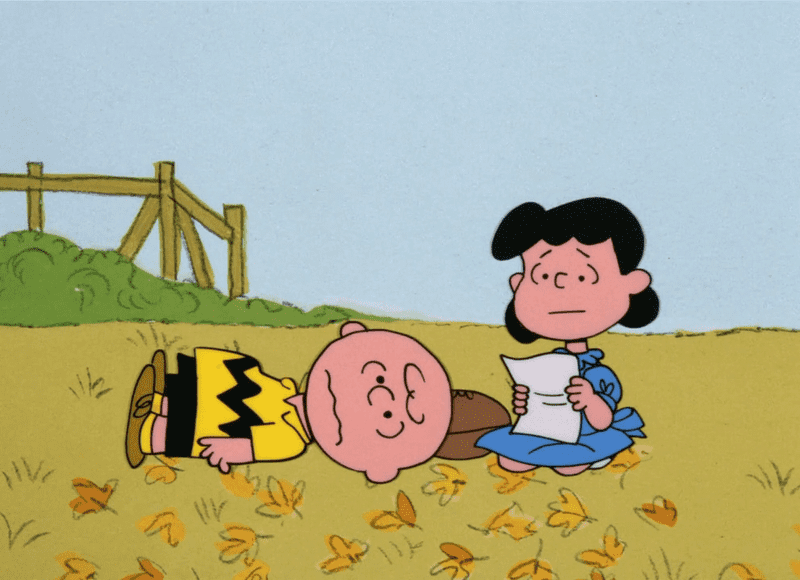
I remember few episodes of Peanuts, when Charlie Brown tries to kick the football and Lucy van Pelt keeps pulling it away last minute, making him fall on his back every single time. Every time she convinces him to kick the ball, and every time he questions trust. Lucy would convince him with different tricks; When she was a psychiatrist, he asks “After all, if you can’t trust your own psychiatrist, who can you trust?” Once she brings in a signed document saying “This time you can trust me…See, here’s a signed document that says you can trust me” and Charlie replies: “It is signed. IT’S A SIGNED DOCUMENT! I guess if you have a signed document in your possession you can’t go wrong” only for him to go running like every time and fall on his back because “peculiar thing about this document, it was never notarized”.

A scene from “It’s the Great Pumpkin, Charlie Brown.”

 So what is trust, then?

We have plenty of examples of why we can’t trust others and mistrust has been a part of our evolutionary history; Our ancestors who trusted less, had more chances of survival. Sometimes it works, and we’re giving ourselves a well-deserved pat on the back: “hey, you did the right thing”. More often than that though, we are wrong, and the hunter gatherer’s era is gone.  We need trust. Without it, our communities, organisations, society couldn’t function at all.

Pulitzer award winner, Erik Erikson said that we face a crisis in the first year of our lives that determines how strong our urge for comfort, predictability and reliability is. If the caregiver (usually the mother) responds predictably, reliably and lovingly towards us, we develop a strong sense of trust. This predictable, reliable, loving sense of trust helps us create communities and work together. We can safely say that trust starts from the moment you are born and it grows “step by step”.

Photo by Suzy Hazelwood on Pexels.com
Father helping his daughter walk

Key to being trustworthy is to act consistently at all times and in all circumstances, for yourself and for others.

“It takes twenty years to build you reputation and five minutes to ruin it” – Warren Buffet

Trust is probably the most beneficial value in relationships and organisations.

The first box every leader should tick is to inspire trust in others. This ability (many psychologists consider trust as a personality trait) is the foundation stone for every organisation, relationship and success story.

  • Are you trustworthy?
  • What makes people trust you?

Before considering gaining someone else’s trust, you must trust yourself; you must have credibility for yourself, first. Self-trust is derived from your capabilities to keep your promises, set and achieve goals and get results. If you “walk your talk” you’re on the right track.  The inner sense of satisfaction and consistency will reflect on others and they’ll soon start trusting you too. If you don’t know what self-credibility is, ask yourself this: Do I keep the promises I make to myself? E.g. : I’ll stop watching TV, I’ll give him/her a call in 5 minutes, I’ll start exercising, and so on…when you don’t keep your promises to self, you’ll make space for procrastination and soon your unconscious self won’t see the value in your actions, hence it will start making excuses instead of being proactive.

Enhancing credibility for yourself and inevitably, for others

Credibility is something you can build and boost by making decisions and taking actions in line with what you believe in and what you stand for. Equally, you’re breaking your own credibility when you make decisions you don’t feel good about or against your values.  

Taking it step by step.

Integrity. Integrity is known as “the quality of being honest and having strong moral principles”, but there’s much more to it; integrity is putting more effort in what is right rather than being right,  being brave and being congruent – making your beliefs and values blend in a beautiful scent you can proudly wear anywhere you go.

How do you boost it ?

  1. Start by making and keeping personal promises. This might sound exciting and you’ll probably feel like over-committing …Less is more. Add weight to your promises. Make them matter! If you want to start exercising, promise yourself you’ll do it for 30 minutes instead of 1 hour; Promise a friend you’ll be there, be there! Remember, friends will always accept a good excuse, but your own self, won’t. And it will understand that excuses are the way to go.
  2. Be open and honest – It takes courage to say ‘no’ and to admit that we don’t have everything sorted out. Embrace that. Instead of making a commitment you can’t keep, look at an objective overview of why it cannot be done (not an excuse).
  3. Create your superhero – this is my favourite! Think of yourself as someone great and create a routine for that someone. What actions would he/she take? Will he/she be there when their friends need them? What books will he/she read? Keep that superhero up and running!

Intent.  Why is Intent a part of my credibility, you may ask. Intent is a huge part of credibility because it’s driven by motivation – both intrinsic and extrinsic – and behaviour.

How do you improve intent?

  1. Check in with yourself once in a while. Sometimes we get so hyped in achieving a goal, that we forget to check what motivated us in the first place.
  2. Be loud and clear about your objectives. That will align your intention to your goals and people will know what to expect from you – no surprises there.
  3. Practice altruism, not selfishness. Be supportive to people around, don’t compare yourself to others and don’t hate others for what they have achieved.

Capabilities. Capability is a great combination of talent and skills. Your either born with it or you get to master something through learning in your lifetime. That’s why some managers are perceived as leaders, because they have a knack for leading others and inspiring trust.

How do you improve capabilities?

  1. Update and Upgrade. That’s the good news here, whether there’s something you’re born with or an ability/skill you learnt, you can improve, excel and master it. Do that!
  2. Find your strength and use it. Don’t waste time focusing on weaknesses (acknowledge them though – that will help you know yourself better)
  3. Have you map handy. Know where you’re going, nobody likes to follow someone who’s lost and lacks confidence.

Results. Results are important. Only when you have tangible and visible results your credibility boosts both within yourself and in front of others.

How do you get more results?

  1. Be accountable for your actions and take responsibility. Think of the task you want to complete and follow anything in your power and control to do so. If it doesn’t work, try again, try different, use connections. Don’t blame people or organisations.
  2. Be persistent
  3. Celebrate your wins! It may sound cliché, but hey! You did it! No matter how small your promise to yourself has been, you kept it. Keep it up!

Reflection.

A significant way to show credibility is to willingly make the choice to trust others. We are wired to believe in people who believe in us, and it works magic both ways, just like a mirror. When someone says: “I trust you”, you’ll give your best to make that person believe they made the right choice to trust you.

Trust is actually contagious: you receive it, you have it, you give it. If you need one more example of this contagion, think of F1 drivers: every single member of the team trusts that the other member will do exactly what they promised to do, so that they can win the race or the championship.

https://www.racefans.net/2015/12/09/2015-f1-season-in-pictures/sne25450/
Lewis Hamilton with Mercedes team – Circuit of Americas 2015

Restore.

Say you started well, got someone to trust you and then … You broke that trust. For whatever reason that happened and no matter how much you screwed up, be a good connoisseur and restore this great piece of art. First, try to fix the initial problem. If that’s not possible, work hard to make the person trust you again, coordinate your actions (remember consistency is key), sew the pieces back together and do better in the future.

“We must trust and believe in people or life becomes impossible” – Anton Checkhov

Control and influence or learn to let go


Puppeteer – Kamilla Zarbaliyeva

“If you don’t like something, change it. If you can’t change it, change your attitude” – Maya Angelou

Human beings seek control and dislike uncertainty, ambiguity and the unknown. We have expectations and we put our hope in people, situations and organisations. We go to work and expect to get a promotion, we make a friend and we expect support, we plan a holiday and we expect it to meet our dreams. Yet , it doesn’t work this way, it doesn’t always happen to have your expectations met. And that’s when you get hurt, you suffer, you hate others for getting “what you deserved in the first place” , you quit, you have negative thoughts and there goes the long chain of bitterness.

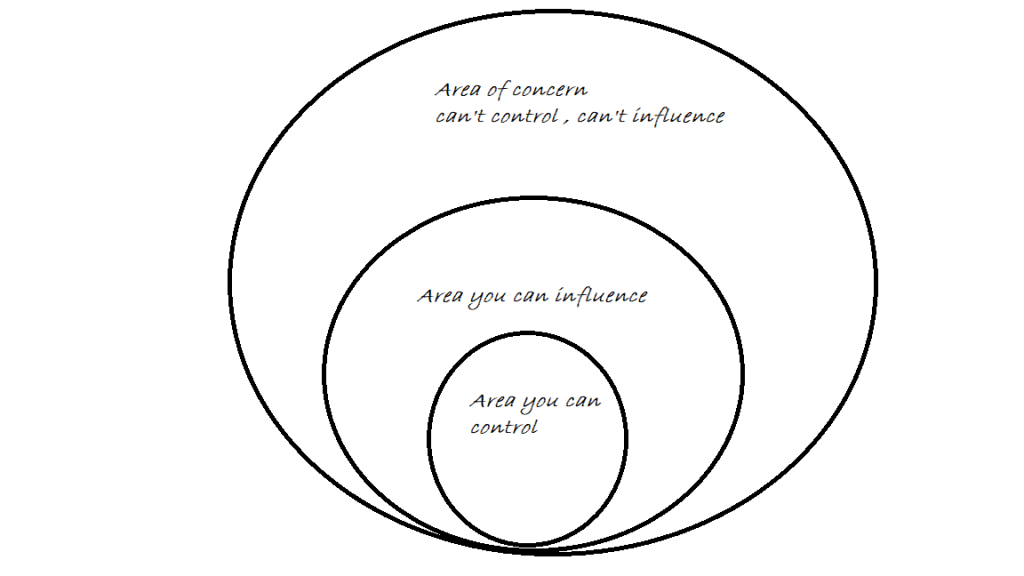
Why do people get stuck in the chain of bitterness? Because they can’t seem to understand their area of control and influence and more importantly the area where they don’t have any of them.

Take a look at the sphere below:

At the core of it, it’s you and the wonderful area you can control.

Immediately outside it, is the area you can influence.

Once your influence area ends, there’s a massive area of concern and unknown that you can’t control or influence.

For example:

You can control the time you leave the house but you can’t control the traffic to the office.

You can influence your colleague to cover for you but you can’t control what she thinks of you.

The world is full of triggers that fill you with frustration, disappointment, jealousy and pain.

What can you do about it?  

Focus on the things you can control and influence.

Start by acknowledging what you actually control and influence everyday ( eg: what time you wake up, what you have for breakfast – whether you choose to have breakfast at all, what means of transport you use to go to work, how you respond to people, your attitude, how much effort you put into what you do) and less on what you can’t influence or control (what people think of you, how bad the traffic gets on your way to work, what others achieve, what the weather looks like)

A great way to get going would be to start using the sphere and write your own details in each part of it. If you’re still confused whether something is in your control or not, ask yourself : Can I change it? Can I do it differently? If the answer is yes, then you control or influence the task, hence the outcome depends on you.

If the answer is no, don’t beat yourself up, work on enlarging your sphere of influence/control by connecting with people and investing in yourself. Will share more tips and tricks about this in future articles.

“Life is to be lived, not controlled; and humanity is won by continuing to play in face of certain defeat.” – Ralph Ellison, Invisible Man

10 things to focus on while @home

Tell someone they can do anything, and they won’t know what to do. Tell them what they can’t do and they’ll know exactly what to do. – Anonymous

Funny enough, reverse psychology seems to have a go at people nowadays and people give in. We are told to stay in, we prefer to go out, we are told to buy our usual grocery list, we panic buy, we are told to work from home, we think we’d be better off in the office… put us on lockdown and you’ll see how many reasons we’ll have to be on the streets… it’s human. (and so are the excuses)

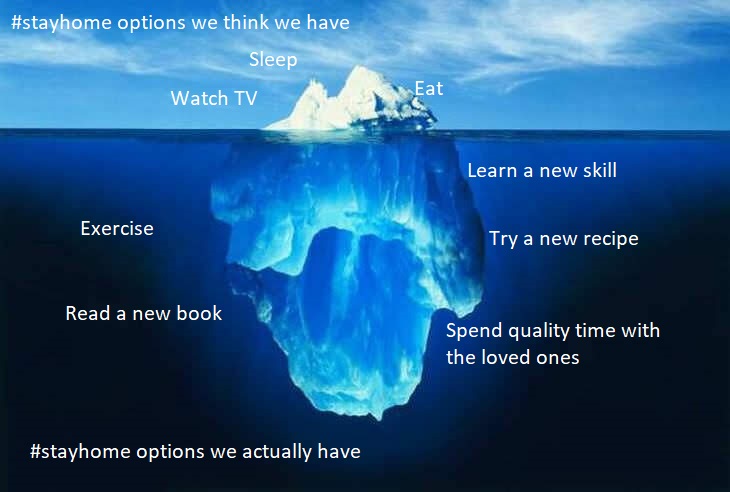
Staying home comes with boredom and less activity, but don’t get stuck at the tip of the iceberg! Dive in and choose to make your stay better and more enjoyable. There are plenty of pros in staying home, not only eat, watch TV, sleep; that’s just a part of it. Have a look at the 10 things to do while @home checklist:

  • Read a book (yes, I know. That’s the no 1 advice you’ve heard and that’s what you’ve been thinking too! but…when was the last time you read for 2 hours without falling asleep, without checking your phone?) here is a list for inspiration from The Independent
  • Cook something new (you bought everything in the grocery store, you might as well try a new a new recipe and here’s one of my favourites )
  • Exercise ( get yourself back on track, go out for a walk in the evening, try working out at home if space allows it)
  • Learn a new skill ( painting maybe? I don’t know, whatever passion you left off because you didn’t have time, invest in it)
  • Keep in touch with friends and family (if you can’t visit, it doesn’t mean you can’t call; don’t make the mistake to distance yourself from the loved ones just because you have to stay indoors)
  • Read news once a day only (your well-being is important)
  • Eat well (not more) and stay hydrated
  • Take breaks when working from home (stick to lunch break at lunch and in between take 5 minutes break every 1 hour)
  • Try to keep household activities separate from work activities (taking a work call while chopping veggies is the not the right approach)
  • If you enjoy watching movies, focus on comedies

Other than that, stay positive and treat yourself and your colleagues with kindness. This short term crisis will end soon and you’ll be back on track in no time.

mamihlapinatapai

! Fun Fact Friday

The word “mamihlapinatapai” comes from the near extinct Yaghan language of the Yagán Idians of Tierra del Fuego. It has been in the Guinness Book of Records in 1993 and has been described as the “most succinct” word in any language. The word has a few translations; one more romantic: “a look shared by two people, each wishing that the other would initiate something they both desire but which neither wants to begin” and one more (im)practical “looking at each other hoping that the other will offer to do something that both parties desire to have done but are unwilling to do so themselves” .

Going from its difficult definition to our daily work or personal situations, the translation of this word becomes an interesting topic since we all have a side that makes us want to get things done without actually doing anything about it and we hope that by looking at someone, problems will be solved miraculously. And this covers heaps of scenarios: from partners sorting out who’s going to do the cooking, lovers waiting for the other to make the first step, to colleagues choosing to do the talking in front of the tough boss.

If you’re shy, afraid, lack confidence or simply don’t want to do something…. find your “mamihlapinatapai” partner!

Got a conflict? Here are 5 different approaches to tackle it!

Managers deal with conflict all the time. As a leader, your role is to understand the mission of the workgroup, how that supports the mission of the organisation, articulate that mission to the employees and others outside the organisation and support your team to accomplish that mission. That frequently involves resolving differences and disagreement within the team. Often, we don’t label this as “conflict resolution” because we listen, respond and resolve them in the workplace before these differences accumulate enough emotional dust to be visible.

What is “conflict” then? Conflict is mostly defined as a serious disagreement, a dispute or opposing arguments. To make it simpler, conflict happens when what you want, need or expect interferes with what someone else wants, needs or expects. It may be a disagreement over what information to add to your Friday presentation, data, resources, or it may go as far as relationships, values and identity.

Conflict has different levels and the more you leave it unsolved the closer you get to unsolvable situations (which may require an outsider or even legal advice to fix it). Clearly, no one wants to reach that point.

When dealing with a conflict, choose one of the below characteristics that describes you best:

  1. I let it go, even if it means that nothing is settled.
  2. I prefer to do what others want for the good of the relationship.
  3. I focus more on my goals and less on what others want.
  4. Everyone should accept a little less than what she / he wants so we can all get back to work.
  5. I go through great lengths to understand what is important to others and to make sure they understand what is important to me.

Most of us have preferences and patterns for the choices we make. And sometimes our approach works just fine. Some other times the same approach may be self-defeating and limiting. Understanding your own approach to conflict can help you make better decisions when dealing with it. Learning how people you work with approach it, will give you additional tools to manage conflict effectively.

The good news is: there is no right approach to deal with conflicts, and each one may be appropriate in certain circumstance and inappropriate in others. The art of conflict resolution stands in learning how to use different style with different people or situations.

Abraham Maslow said: “When the only tool you have is a hammer, every problem looks like a nail.”

For each of the statements mentioned at the beginning of the article, there is an approach as shown in the picture.

The first statement: “I let it go, even if it means that nothing is settled” sits in the lower left side of the figure and it’s a statement of avoiding.

The positive side of the AVOIDING:

  • Letting go of the problems that in the big scheme of things are just not that big a deal.
  • Avoiding a greater conflict, not banging your head against a brick wall to no good end.
  • Sometimes people need to cool off … or you need to cool off; or you just need some time to understand the situation, to gather more information. This is a tactical avoidance; it’s a short-term response. It gives you time to revisit the conflict when you are better prepared.

The downside of AVOIDING:

  • Small problems get bigger. Avoidance may seem the best road to take, until a negative behaviour becomes a pattern.
  • It may cause unfair treatment, letting go of a small conflict with one of the employees may reduce motivation in others: “Why bother doing the right thing when he/she gets away with it?”
  • No records. Thinking it’s solving itself, doesn’t really work. Avoiding situations of conflict with a poor performer without keeping any records for months or years will give you no justification to take corrective actions against him/her because of lack of evidence.

Often appropriate – when the problem is relatively unimportant, time is short and a decision is not necessary.

Often inappropriate – when negative behaviour builds up, feelings linger and problems that need to be addressed are not resolved.

Tip: Create a safe environment to deal with the issues, give the other party time to explain / fix the problem.

The second statement: “I prefer to do what others want for the good of the relationship” sits on the lower right side of the figure and it’s a statement of accommodating.

The positive side of ACCOMMODATING:

  • Accommodating springs from great feelings of empathy and compassion: “your problem is greater than mine”, “ what can I do to help you?”
  • It shows a great spirit of cooperation. When someone is piled up with deadlines, the accommodating one will be there to show support and help.
  • It’s a great asset when dealing with customer service, both internally and externally.

The downside of ACCOMMODATING:

  • Unlimited accommodating can’t be sustained over time, you’ll eventually run out of energy or resources.
  • Sometime it may encourage others to take advantage of your style.
  • You risk missing your own deadlines to help others.

Often appropriate – when the issue greater than your tasks and favours are traded over time.

Often inappropriate – when others keep benefiting from your kindness and experience.

Tip: Raise the problems without confrontation, assure the other person that the relationship or personality traits are not issue.

The third statement: “I focus more on my goals and less on what others want” sits in the upper left side of the figure and it’s a statement of directing.

The positive side of DIRECTING:

  • Solid directions – a good argument can bring everyone together.
  • States clear terms of what needs to be done, when and how. Everyone enjoys working with a manager who’s confident and sets expectations right.
  • Healthy directing brings out the best in each of us. The energy and thought processes that go with good directing raise the standards for everyone.

The downside of DIRECTING:

  • People who are always in a competitive mode are often fixated on being right and other ideas may not be considered or solicitated.
  • Every disagreement may turn into a win-lose contest.
  • Even the best managers need the support of others, if you keep your competitive mode always on, you may quickly realise that you fight all the battles by yourself.

Often appropriate: when an immediate decision is needed.

Often inappropriate: when others ideas are not taken into consideration it may lead to frustration and resentment.

Tip: Respect the other person’s knowledge and experience, help him/her identify how is it in their best interest to cooperate or listen.

The fourth statement: “Everyone should accept a little less than what she / he wants so we can all get back to work” sits in the upper middle side of the figure and it’s a statement of compromising.

The positive side of COMPROMISING:

  • Traditional bargaining may seem to work well with here: “I help you, you help me”, “I give something and I get something in return”
  • When you have limited resources, compromising has the potential to give everyone an acceptable resolution

The downside of COMPROMISING:

  • People can be too quick to jump to an intermediate solution and get a less satisfactory result.
  • Compromising could become more of a game than a decision making tool. When people expect a compromising situation, they may thwart the process, expecting a “good enough solution”

Often appropriate: when finding a solution is better than winning.

Often inappropriate: when you accept less and it affects the business or the people.

Tip: Slow down. Gather information, make sure you understand what’s at stake before dropping to conclusions.

The fifth statement: “I go through great lengths to understand what is important to others and to make sure they understand what is important to me” sits in the upper right side of the figure and it’s a statement of collaborating.

The positive side of COLLABORATING:

  • Everyone has their needs and expectations met.
  • Collaborating on a solution builds support for the decision, by working together, everyone’s opinion matters and when leaving the room employees have a stronger sense of commitment and ownership.
  • Collaborating builds relationships. Trust between employees and managers strengthens.

The downside of COLLABORATING:

  • Sometimes collaborating takes more time than anyone has.
  • Collaborating may be used to not making a decision at all
  • When the resources are limited, there is no possible way to come to a conclusion that satisfies everyone.

Often appropriate: when both the issue and the relationship are important to both parties.

Often inappropriate: when the resources are limited, time is short and the issue is unimportant.

Tip: Set realistic deadlines and expectations. Encourage the other party to take responsibility for the decisions without fear.

Balancing organisation’s needs with your employees’ needs is not an easy task, and as leader you may need to change your style once in a while, according to the issues you solve or the people you deal with. Try as much as possible to get to know your team and bear in mind everyone has a different style when dealing with problems and that their style may change when under pressure. (As yours may change too)

 Remember, small problems don’t always stay small. Clear and regular communication could become your ally and perhaps you don’t have to deal with conflicts at all.

 “Honest disagreement is often a good sign of progress.” (Mahatma Gandhi)

The Blind Spot

A blind spot is an aspect of your behaviour that you can’t see and impacts others in a negative manner or it prevents you from reaching your goals.

It represents all the other things people know about you, yet you are unaware of; for example: you’re being very loud in a meeting, you’re interrupting others to make a point… Unless someone gives you feedback about it, you cannot begin to correct it.

Business blind spots happen because we lack self-awareness and we fail to see ourselves through someone else’s eyes.

Three reasons that place us in the blind spot:

  • Self-centred approach that leads to poor listening skills
  • Resistance to change that prevents you from growing / learning
  • Not asking for feedback from co-workers (or not working on it when received)

How do you eliminate the blind spots?

  • Get feedback about things you do, formally or informally; Ask questions: “How did you find my presentation?” “ What could I have done better in this meeting?”
  • Observe your co-workers while giving a presentation or a speech: Are they on their phones? Did they start yawning? If so, adjust your style on the go – move to the next topic faster, introduce a joke
  • Work on the feedback received. If someone highlights something you’re doing wrong, work on it, take the time to evaluate your actions

Continuous learning  and self-assessment will put you on the right track and clear your way to success.

What do you think about blind spots? Did you identify any in your area?